

Saint of the Year · St. Margaret School
St. Francis of Assisi
1181 – 1226
"Start by doing what's necessary, then what's possible,
and suddenly you are doing the impossible."
His life
Born Giovanni di Pietro di Bernardone around 1181 in Assisi, a prosperous hill town in central Italy, the boy who would become one of history's most beloved saints began life in comfort and ambition. His father Pietro was a wealthy cloth merchant; his mother, Pica, is believed to have been of French origin — and it was she who had her son baptized Giovanni, though his father renamed him Francesco, "the Frenchman," upon returning from a trading journey to France.
Young Francis grew up enjoying all the pleasures his father's wealth could provide — fine clothes, lavish feasts, and the company of other young men of Assisi who looked to him as their leader in song and celebration. He dreamed of glory as a knight. Twice he set out for military campaigns; twice he was turned back — once by illness after a battle near Perugia where he was taken prisoner, and once by a vision from God that bid him return home.
It was in prayer, solitude, and encounter with the suffering poor — especially a leper whose hands he kissed — that Francis began to hear the call to something far greater than knighthood. God was drawing him away from the world he had known and into a life of radical poverty, humility, and love.
"Praised be You, my Lord, with all Your creatures, especially Sir Brother Sun, who is the day and through whom You give us light. And he is beautiful and radiant with great splendor; and bears a likeness of You, Most High."The Canticle of the Creatures, St. Francis of Assisi, c. 1225
"Let all of us, brothers, consider the Good Shepherd who bore the suffering of the cross to save His sheep. The Lord's sheep followed Him in tribulation and persecution, in shame and hunger, in weakness and temptation, and in other ways; and for these things they received eternal life from the Lord."The Admonitions, VI — St. Francis of Assisi
The prayer before the Cross of San Damiano
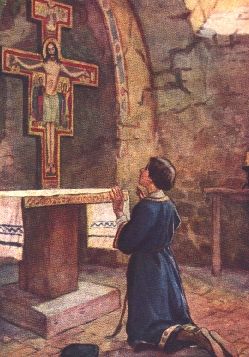
Around 1205, as Francis wandered the outskirts of Assisi in spiritual restlessness, he stopped to pray in the crumbling chapel of San Damiano. Before a large painted Byzantine crucifix, he knelt and poured out his heart to God. It was there that the voice of Christ spoke to him from the cross.
Francis's prayer before the Cross
Most High, glorious God,
enlighten the darkness of my heart
and give me true faith,
certain hope,
and perfect charity,
sense and knowledge, Lord,
that I may carry out
Your holy and true command.
From the cross came the words: "Francis, go and repair my house, which as you see is falling into ruin." Taking the command literally at first, Francis sold cloth from his father's warehouse to pay for repairs to the chapel — an act that brought him into open conflict with his father and set him irrevocably on the path of radical discipleship.
His calling
The break with his father came dramatically in the town square of Assisi, before the bishop. Pietro di Bernardone had dragged Francis to court to reclaim the money his son had given away. Francis responded by stripping off his fine clothes, returning them to his father, and declaring: "Until now I have called you my father on earth; from now on I desire to say only 'Our Father, who art in heaven.'"
Standing naked before the crowd, he wrapped himself in the bishop's cloak and walked away from wealth, family, and social standing forever. He would spend the next years in prayer and manual labor — rebuilding San Damiano, caring for lepers, begging for stones to repair other ruined chapels in the hills around Assisi.
The call to radical poverty
In 1208, hearing the Gospel passage from Matthew 10 read at Mass — where Jesus sends out his disciples without gold, silver, bag, or extra tunic — Francis recognized his mission with absolute clarity. He threw off his sandals, set aside his walking stick, and began to preach penance and peace to any who would listen. Others were drawn to him. The Franciscan brotherhood had begun.
Meeting with Pope Innocent III
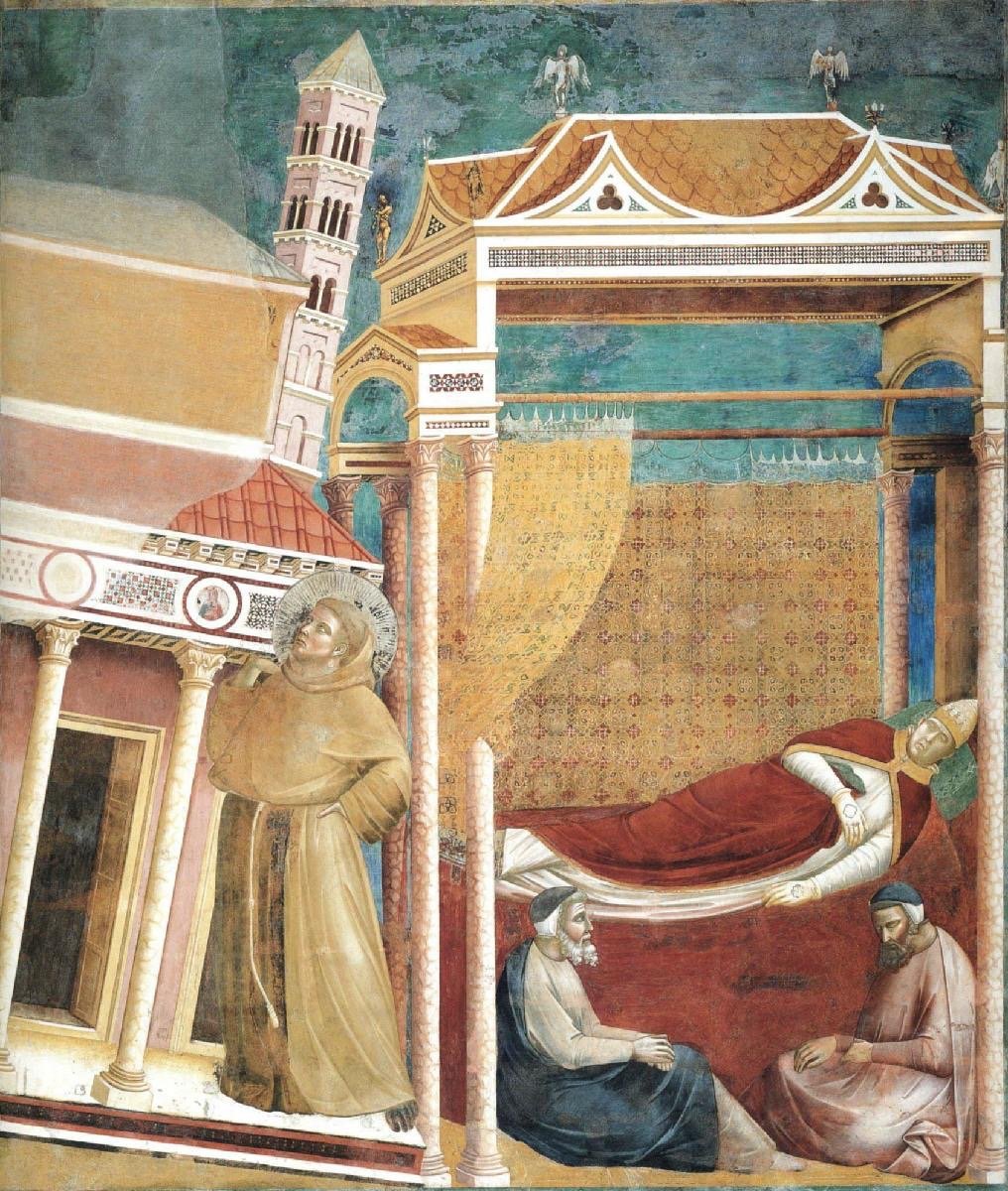
By 1209, Francis and his first eleven brothers had written a simple rule of life and traveled to Rome to seek approval from Pope Innocent III — one of the most powerful popes in history. The meeting between the barefoot beggar from Assisi and the sovereign of Christendom was extraordinary.
Innocent initially sent Francis away, but that night had a dream in which he saw the Lateran Basilica — the mother church of Christendom — leaning dangerously to one side. A small, poor man held it up on his shoulders. Recognizing Francis as the man in his dream, the pope summoned him back, gave his approval to the rule, and granted Francis and his brothers permission to preach penance throughout the world.
This was not merely a bureaucratic moment — it was a providential one. The Church was struggling with heresy, corruption, and decline. God had sent a poor man with empty hands to rebuild it, just as he had told Francis at San Damiano.
The stigmata

In September 1224, two years before his death, Francis withdrew to the mountain hermitage of La Verna in Tuscany for a period of prayer and fasting. On the feast of the Exaltation of the Holy Cross, while praying in ecstasy, he had a vision of a seraph — a six-winged angel in the form of a crucified man — descending toward him from heaven.
When the vision faded, Francis discovered that the wounds of Christ's Passion had been impressed upon his own body: nail wounds in his hands and feet, and a wound in his side as from a spear. He carried these sacred wounds — the stigmata — until his death, doing his best to conceal them out of humility.
"My brothers, my brothers, God has called me to walk in the way of humility, and showed me the way of simplicity. I do not want you to name any other Rule for me — not that of St. Augustine, nor of St. Bernard, nor of St. Benedict — but the Lord has told me what he wanted: that I should be a new fool in the world."St. Francis of Assisi
Francis became the first person in Church history to bear the stigmata, a mystical participation in the suffering of Christ that reflected the totality of his union with the crucified Lord.
Franciscan symbols
Two symbols have become inseparably associated with St. Francis and the Franciscan tradition: the San Damiano Cross and the Tau Cross. Each carries deep spiritual meaning rooted in Scripture, history, and Francis's own charism.
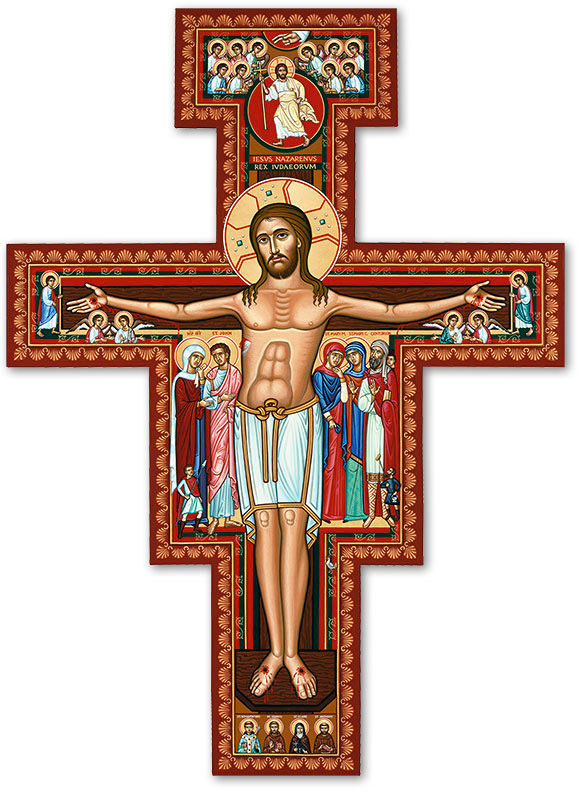
The San Damiano Cross
A large Byzantine-style painted crucifix that originally hung in the ruined chapel of San Damiano near Assisi. It was before this cross that Francis heard the voice of Christ calling him to "repair my house." It became the spiritual touchstone of the Franciscan movement.
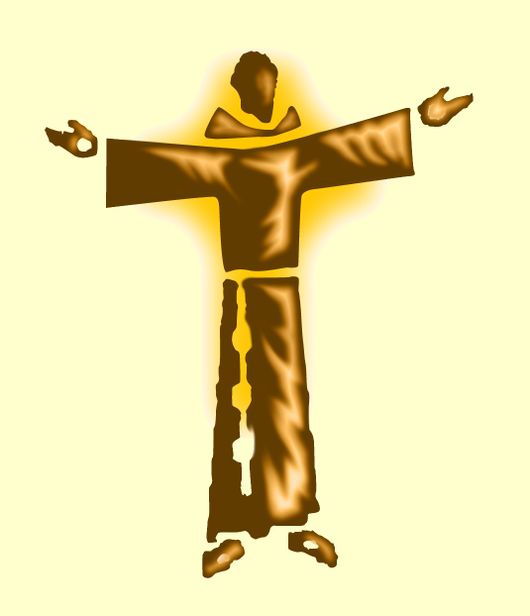
The Tau Cross
Shaped like the Greek letter Tau (T), this ancient cross symbol was referenced by the prophet Ezekiel as the mark God placed on those who wept over the sins of Israel. Francis adopted the Tau as his personal symbol, signing his letters with it and using it as a blessing. It remains central to Franciscan identity.
Figures depicted on the San Damiano Cross
The Transitus — his passing
By the autumn of 1226, Francis was gravely ill — nearly blind, his body weakened by years of austere penance and the wounds of the stigmata. He asked to be carried back to Assisi, to die in the place where God had called him.
On the evening of October 3, 1226, lying on the bare ground of the Portiuncula chapel — the humble little church that was the cradle of the Franciscan Order — Francis asked that the passage from the Gospel of John be read to him. He then sang Psalm 142 in his weakening voice and breathed his last. He was forty-four years old.
"Welcome, my Sister Death."
Francis had written these words in his Canticle of the Creatures, giving thanks to God even for bodily death. He greeted his end not with fear, but with the same radical joy with which he had greeted everything God had given and taken away.
October 3, 1226 · The Portiuncula, Assisi
The evening prayer of the Church on October 3rd each year is called the Transitus — a word meaning "passing over." Franciscan communities around the world gather to remember his death with song, Scripture, and the reading of his final hours. He was canonized less than two years later, in 1228, by Pope Gregory IX — his old friend Cardinal Hugolino — in Assisi itself.
His legacy
Within Francis's own lifetime, the Order of Friars Minor had grown from eleven brothers to thousands, spreading across Europe and beyond. His spiritual daughter Clare of Assisi founded the Order of Poor Ladies — the Poor Clares — with his blessing and guidance. A third order for laypeople followed, allowing ordinary men and women to live Franciscan spirituality in the world.
Francis's legacy reshaped the Church and Western culture. He brought the Gospel out of monasteries and into city squares. He championed the dignity of the poor, the beauty of creation, and the centrality of Christ crucified. He gave the world the first nativity scene — constructed in the town of Greccio in 1223 — to help ordinary people enter into the mystery of the Incarnation.
"When I was in sin, the sight of lepers nauseated me beyond measure; but then God himself led me into their company, and I had pity on them. When I had once become acquainted with them, what had previously nauseated me became a source of spiritual and physical consolation for me."The Testament of St. Francis of Assisi, 1226
Eight hundred years after his death, St. Francis remains among the most recognized and beloved figures in all of Christian history — and among the most relevant. His insistence on simple living, care for the earth, and love of all creatures speaks with startling freshness to our own age. In 2013, the newly elected Pope Jorge Mario Bergoglio chose the name Francis — the first pope ever to do so — in his honor.
His enduring call to humble faith
Francis did not call people to a program or an institution. He called them to a Person — Jesus Christ, poor and crucified, risen and glorious. His life was a living invitation: set down whatever weighs you down, stop grasping for status and security, and follow the Lord who meets you in the face of the poor, in the beauty of creation, in the silence of prayer, and in the fire of the Eucharist.
That call still sounds across the centuries. As students of St. Margaret School walk through this year with Francis as their patron, may they hear it too — and may it change them, as it changed the young cloth merchant from Assisi, forever.